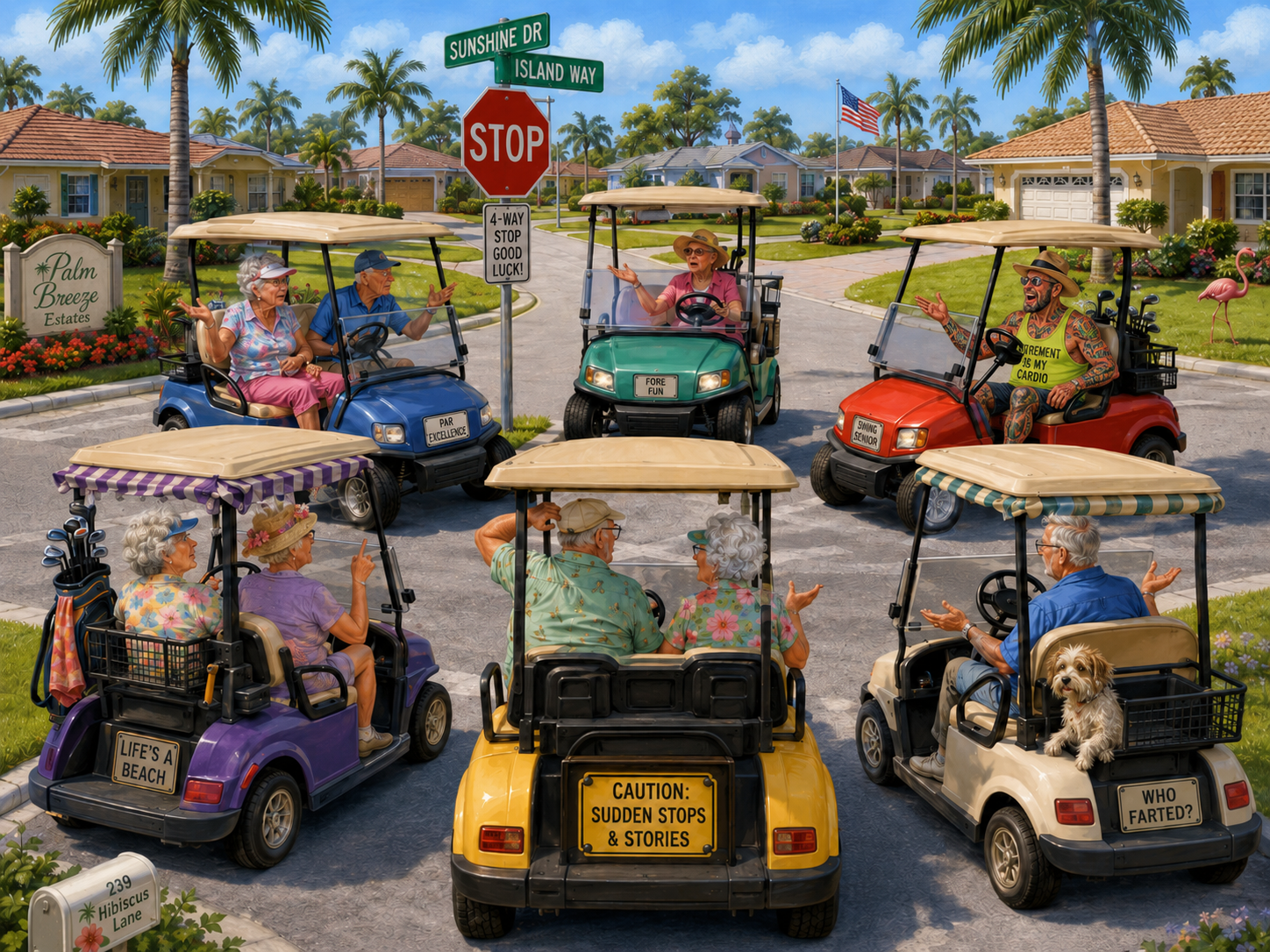
There was a time when a golf cart was a simple machine mostly used by golfers to travel from one disappointing shot to the next while blaming the wind, the sun, the grass or the humidity for a tee shot that landed in the woods or somebody’s pool.
A golfer might hit a ball into the woods, climb into the cart, drive fifty yards and find three other people’s balls before announcing he had made par.
That was the natural order of things.
Then golf carts escaped.
Today, they roam freely through Florida retirement communities, shopping centers, residential streets and, occasionally, public roads, where they quietly and effectively obstruct the flow of traffic.
In a retirement community, the golf cart is no longer transportation. It is a personal statement, a status symbol, a joyride for the dog and, in some cases, a rolling monument to bad judgment.
The basic factory cart is no longer enough.
Now we have lifted carts, lowered carts, carts with chrome wheels, carts painted like Corvettes, carts decorated like pirate ships and carts equipped with more colored lighting than a Tampa strip club.
I recently saw one with oversized tires, blue lights underneath and a sound system loud enough to be heard in neighboring counties.
The driver appeared to be about eighty-six and wore a neon-colored tank top revealing droopy, solar-damaged skin tattooed from neck to knuckles. He seemed oblivious to the glares from motorists and people working in their yards.
Golf-cart ownership has virtually created a class system inside retirement communities.
At the bottom is the person with the plain factory cart. This is the elderly equivalent of arriving at a high-school reunion in a rented compact car.
Above him is the owner with custom seats and a matching roof. Then comes the cart with aluminum wheels, a backup camera, a built-in cooler and enough cup holders to support a small wedding reception.
At the top is the golf-cart aristocrat whose vehicle has doors, air conditioning, windshield wipers, leather seats, Bluetooth and navigation, along with monthly payments larger than those on his first house.
At that point, it is no longer a golf cart. It is a very small Cadillac suffering an identity crisis.
The most dangerous location in any retirement community is not the swimming pool, the pickleball court or the early-bird buffet.
It is the four-way stop at 9 05 on a Tuesday morning.
That is when six golf carts arrive at the intersection, each driven by someone who believes the other five have surrendered the right-of-way.
Nobody moves.
Everyone waves.
One driver waves another through. That driver waves back. A third joins in. Soon, everyone is waving so enthusiastically it looks like a parade for a visiting president.
Then all six move at once. A collision is narrowly avoided, and each driver leaves convinced the other five were at fault.
Golf-cart drivers also stop in the middle of the road to conduct extended conversations.
Two carts approach from opposite directions.
“How’s your knee?”
“Better. How’s your back?”
“About the same.”
Then they discuss medical appointments, grandchildren, property taxes, lawn service, cataracts and the suspicious behavior of the new couple on Little Tee Lane.
Meanwhile, traffic backs up to the county line.
Nobody honks because everyone knows the drivers and does not want to become the lead story in the community newsletter.
Some carts carry dogs that are often more alert than the driver.
The dog watches the road, notices pedestrians and appears deeply concerned about the speed at which they are approaching the retention pond.
I have seen dogs lean toward the steering wheel as though preparing to take over.
In some cases, I would support that.
Then there are golf-cart turn signals.
Most carts have them. Few drivers use them.
The driver simply slows down, looks vaguely toward a row of houses and turns without warning.
Other times, the signal starts blinking when the driver bumps it while leaving the house.
You follow the cart for half a mile, waiting for the promised turn. It passes six intersections, circles the clubhouse and continues toward the front gate with the left signal still flashing.
The driver is not turning.
He is merely signaling that turning is a long-term possibility.
Golf carts were tolerable when they remained inside retirement communities. But some have begun appearing on larger roads, where they travel beside actual automobiles with engines, airbags and drivers who thought they might reach their destinations before sundown.
There is nothing quite like driving fifty-five miles an hour and suddenly encountering a golf cart moving at the speed of continental drift.
The cart usually contains two cheerful retirees, a small dog and three bags of groceries.
The driver looks into his mirror, sees nineteen vehicles stacked behind him and continues without concern.
He has nowhere to be.
He is retired.
The rest of us are merely supporting characters in his leisurely journey to buy bananas.
Passing is rarely possible because the road curves, traffic approaches from the opposite direction, and the cart driver has positioned himself exactly far enough from the shoulder to prevent civilization from continuing.
Eventually, the line behind him includes delivery trucks, lawn trailers, school buses and an ambulance with a patient in need of emergency care.
Just when you think the golf cart is Florida’s slowest-moving obstacle, along comes the electric bicycle.
The e-bike rider is a fascinating, relatively new species.
He may be wearing professional cycling clothes, a motorcycle helmet and mirrored sunglasses, making him look prepared for the Tour de France. Yet he is carrying a loaf of bread, a fishing pole and a plastic bag from the liquor store.
Some e-bike riders travel on the road. Others travel on sidewalks. A few switch between the two depending on which location creates the greatest danger.
They launch from traffic lights like silent rockets, dart among vehicles weighing thousands of pounds more and then top out at a speed just low enough to keep every car behind them from reaching third gear.
You finally move left to pass, and the rider suddenly crosses the road without warning for some reason.
E-bike riders rarely signal. Some extend an arm, but the gesture is difficult to interpret.
Are they turning right, pointing at a bird or experiencing shoulder pain?
By the time you decide, they have crossed two lanes and disappeared behind a Dollar General.
On sidewalks, electric bicycles become silent guided missiles.
A pedestrian can be strolling peacefully toward the clubhouse when a voice suddenly whispers from twelve inches behind him, “On your left.”
At seventy-five, that is not a traffic warning.
It is a cardiac stress test.
The bicycle passes at twenty-eight miles an hour, leaving the pedestrian with a hand over their gaping mouth while the rider disappears into the distance.
Even more alarming is a lane splitting e-biker seated upright at top speed with one hand holding a candy bar and the handlebar and the other holding a Big Gulp.
Florida now faces the possibility of golf carts and electric bicycles joining forces.
Together, they could create a silent transportation alliance capable of blocking roads from Tallahassee to Key West.
Imagine a golf cart crawling down the road at twenty three miles an hour while an e-bike attempts to pass it.
The maneuver could take seven miles and attract television coverage.
Cars would stack up. Drivers would miss appointments. Children would grow older. Roadside vendors might begin selling sandwiches to trapped motorists.
By the time the e-bike completed the pass, both vehicles would need charging.
Self-driving technology may eventually improve matters.
A self-driving golf cart could refuse unsafe or premature commands.
“Turn left. Turn left.”
“No. Left is a retention pond.”
“I meant after the pond.”
Self-driving golf carts may be a ways off, but despite my complaints, I understand the appeal.
Golf carts are convenient, fun and suited for short trips around a community. Electric bicycles help people travel farther without requiring the knees, lungs and enthusiasm they had at thirty.
The problem is not always the machine.
It is the human being operating it.
Give a person a golf cart with cup holders, and eventually he will stop in the middle of a road to converse with a neighbor or a fellow traffic impeding golf cart driver.
Give another person an e-bike, and he may decide traffic laws are merely suggestions.
Technology changes, but Florida drivers remain Florida drivers.
They will drive golf carts equipped like luxury automobiles, operate ebikes on sidewalks and park both wherever shade is available.
They will ignore turn signals, misunderstand intersections and insist everyone else is the problem.
Perhaps the safest transportation option is walking.
Unfortunately, in Florida, that means crossing roads filled with golf carts you cannot outrun and sharing sidewalks with silent, careening e-bikes.
So look both ways.
Then look behind you.
And should an old man approach driving a lifted golf cart with blue lights glowing underneath it and “Born to Be Wild” blasting from the speakers - smile and wave, but don’t distract him by making eye contact.