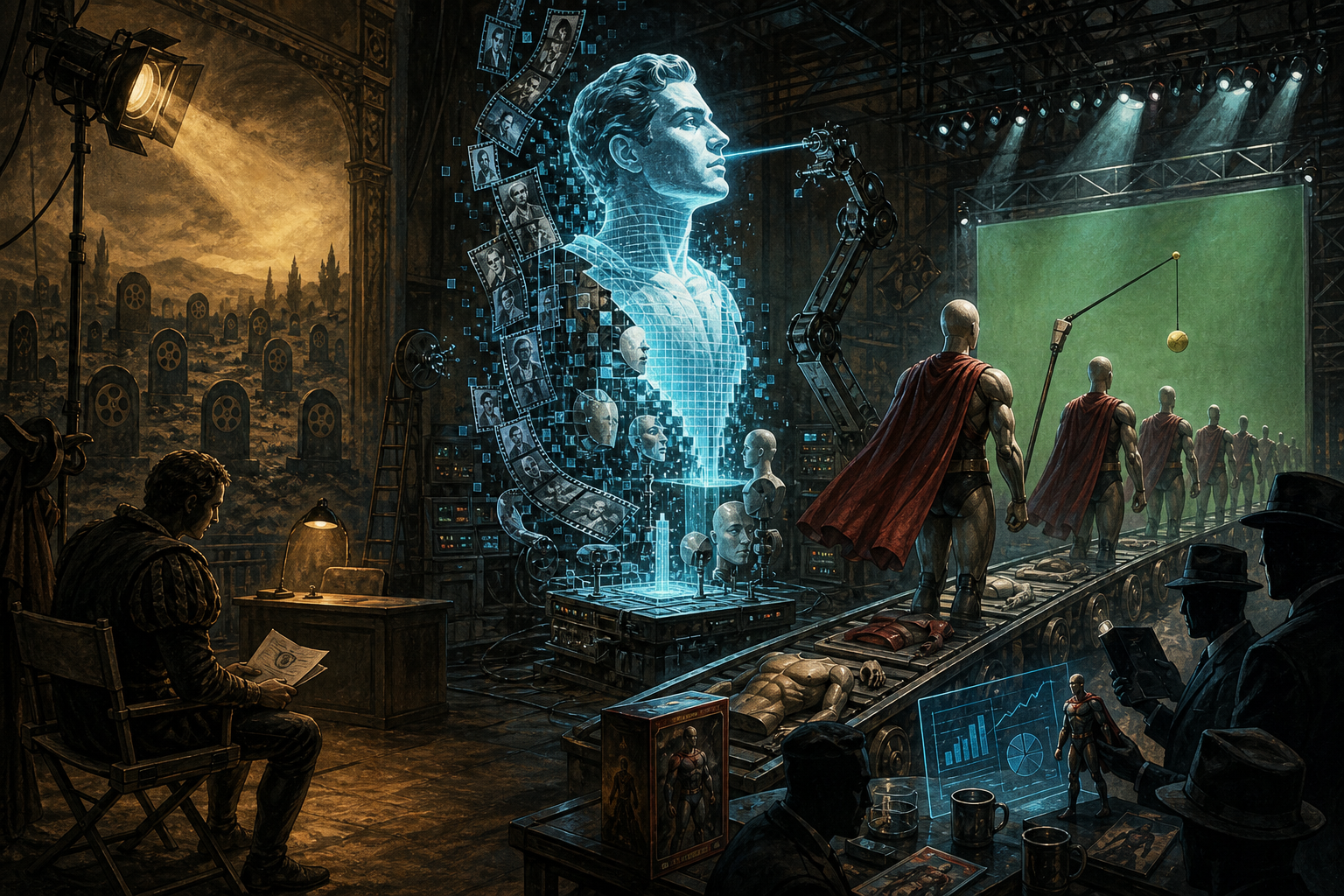
Hollywood is no longer interested in cultivating gifted actors—or even putting such talent on the screen. Instead, it increasingly shuns serious performers in favor of studios staffed by digital taxidermists, using artificial intelligence to resurrect dead actors or make aging stars appear as they did in their heyday. The result turns film history into a graveyard of infinite, artificial nostalgia.
AI is here to stay, but hopefully comic-book feature films are not.
Hollywood’s dependence on creatures from comic books—many of which most of us stopped reading in fourth or fifth grade—has helped create a scarcity of breakout, universally recognized movie stars. No doubt the arrangement is attractive to studios. A computer-generated performer does not arrive late, gain weight, demand a larger trailer, develop political opinions or argue over a contract. It simply obeys.
That is very different from acting.
Acting is the art of performing a fictional role. It requires observation, imagination and the mysterious ability to make an audience believe something the performer knows is false. A superhero production often requires something else: an adequately photogenic person standing before a green wall while pretending to be frightened by a tennis ball on a stick.
The ball will later become an intergalactic death lizard. The actor will later appear on a talk show and describe the experience as “an incredible journey.”
The journey, in many cases, was from one green wall to another.
This is not entirely the fault of actors. A performer cannot summon much human complexity from dialogue written mainly to connect explosions. Laurence Olivier himself might have struggled with, “If we don’t close the quantum portal before midnight, every universe will collapse.”
The actor only needs to say this without looking as though he has just remembered where he parked.
Comic-book cinema did not invent bad acting. Hollywood has always employed a hefty percentage of actors with the emotional range of patio furniture. What has changed is the industrial scale on which acting has become incidental. The performer is often marginalized by synthetic voices, computer-generated bodies, digital skies and forty-seven minutes of collapsing architecture.
The hero wears a mask. The villain is a cloud. The supporting cast consists of pixels. Afterwards, the audience gets sequel-hyping. Movies shouldn’t be like episodes of Columbo. They should stand on their own merit, at least for a week.
Biometric Plundering: Scanning an actor’s body, face and voice so the resulting likeness can be manipulated and monetized long after the original human has gone home—or gone to the hereafter.
In old Hollywood, a studio owned your contract. In new Hollywood, it would like to own your cheekbones.
Algorithmic Archetypes: Replacing nuanced human behavior with characters shaped by market research, audience data and Hollywood’s obnoxious conviction that nobody anywhere should encounter anything unfamiliar.
The hero is wounded but noble. The woman is brilliant but approachable. The child is a tech expert. The mysterious stranger turns out to be the hero’s father, unless he tests better as the hero’s identical twin from another dimension. Did I mention the dog survives.
Necro-Casting: Reanimating a deceased performer through generative technology rather than hiring a living actor who might create something new.
Death, once considered a serious obstacle to accepting a role, is now merely a scheduling complication.
Technology itself is not the enemy. Cinema has always been technological magic. Editing, sound, color, animation and visual effects expanded what filmmakers could imagine. AI may become another legitimate creative instrument. The trouble begins when a tool for enlarging human imagination becomes a mechanism for avoiding it.
A digital resurrection may occasionally serve a film but repeated often enough it becomes weird sort of séance on behalf of corporate economics.
Hollywood is frightened of the new. A dead star arrives with name recognition. A superhero arrives with a cape and built-in audience. A remake arrives with decades of free advertising. A sequel arrives with the assurance that viewers have already paid to see some version of it.
A new actor with an unfamiliar face arrives carrying only talent.
Talent is difficult to measure. It may need years to mature. It can be costly, surprising, temperamental and resistant to branding. It may choose a strange role, reject a lucrative sequel or insist that a character behave like a recognizable human being. From a corporate perspective, talent is inefficient.
A cape is more dependable.
This helps explain why Hollywood can now produce celebrities without producing movie stars. We recognize actors from publicity campaigns and interconnected franchises, yet fewer performers seem able to draw an audience simply by appearing in a film. The machinery has made the brand bigger than the person inside it.
Earlier generations went to see a Cary Grant picture, a Bette Davis picture, a Sidney Poitier picture or a Julia Roberts picture. Today, audiences are asked to see “the next installment.” The billing might as well read:
With Contractually Available Humans
The old studio system was frequently exploitative, but it at least understood that screen presence had more to do with an actor’s persona in real time. Studios searched theaters and drama schools, developed performers, placed them in different roles and allowed audiences to discover what made them distinctive.
The franchise system has a different objective: eliminate any distinctiveness that might interfere with international marketing. Personality is welcome as long as it doesn’t offend the ten-year sequel contract.
Meanwhile faces are artificially smoothed, bodies remodeled and older stars digitally returned to youth. Never mind that wrinkles are evidence of character. Weariness is information. A face that has lived can communicate what a flawless simulation cannot.
In most films today, nobody is young and nobody is old. They are rendered.
To that end, all Comic-book films are not inherently childish - several have displayed wit, intelligence and genuine artistry. But an occasional sophisticated superhero movie does not justify building an industry around caped adults wearing tights and reinforced nightwear while settling disagreements by throwing municipal infrastructure at one another.
When films are created to produce sequels, merchandise, spinoffs and a “cinematic universe,” movies often become two-hour shareholders’ products.
Audiences may not care to recall three television series, four previous films and a streaming special merely to understand why Captain Magnificent is angry with Professor Oblivion.
More often, viewers like a story that begins, develops and ends. They would rather see characters whose personalities are not hidden beneath titanium helmets.
The is truth in the numbers, not in pre-scheduled sequels or AI animation.
The bottom line sets the stage. In 2025, Americans bought 769.2 million tickets in U.S. and Canada, down from 1.6 billion at the 2002 peak. (Comic Basics+1)
This represents a 46% drop since the early 2000s peak. (newsinsights.org)
Only 53% of U.S. adults reported going to a theater in the past year, with 7% never having been.
The industry does not need another invulnerable hero. Audiences crave vulnerable people: actors capable of doubt, desire, shame, humor, cruelty, tenderness and contradiction.
Super Girl can’t make Algorithms act.