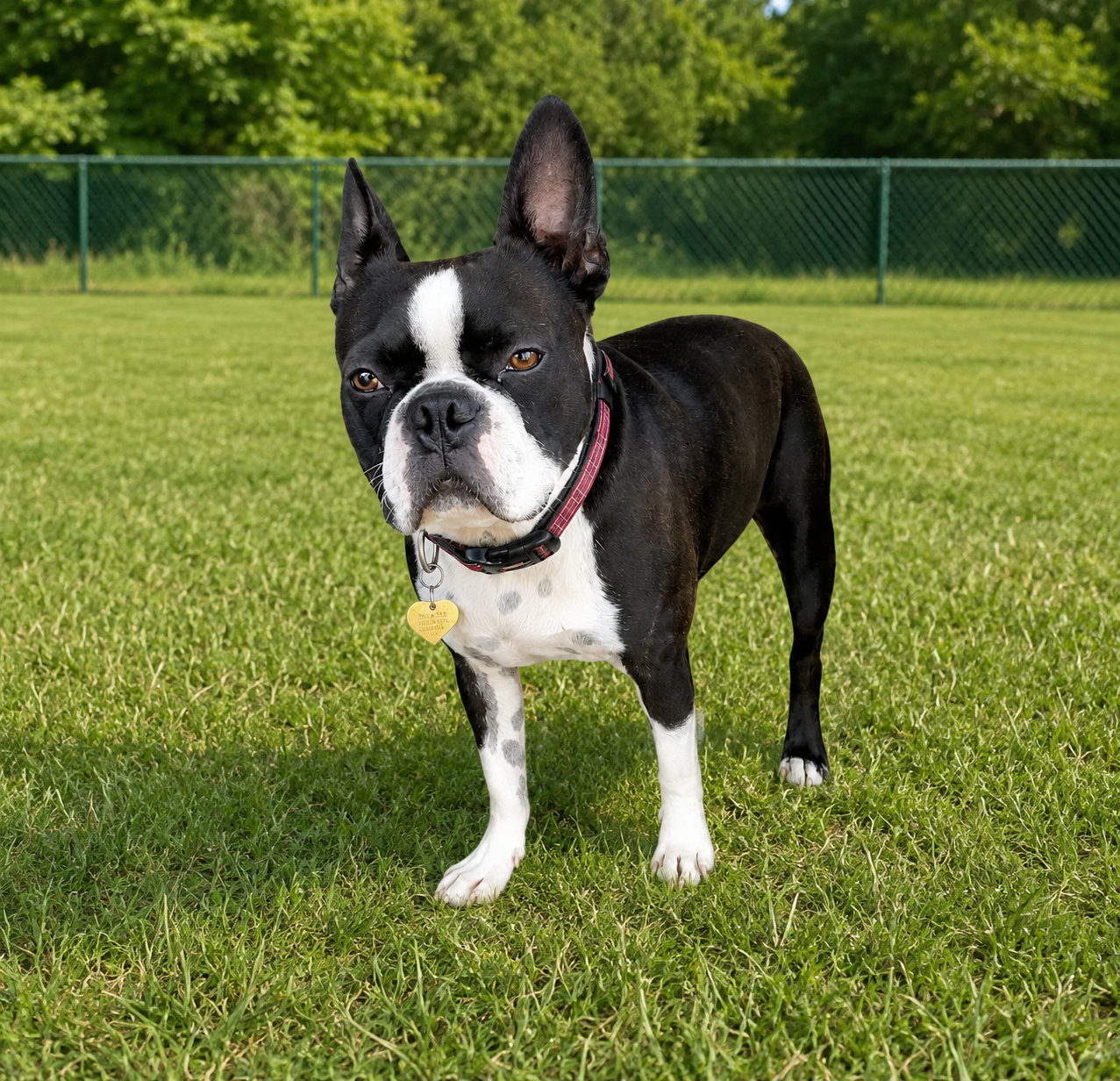
We rescued a Boston Terrier and, after careful consideration of his personality, body language, attitude, and the general possibility that he might someday short out the toaster with sheer emotional electricity, we named him Sparky.
It fits.
Sparky is not a large dog, which is fortunate, because if he were the size of a German shepherd, we would all be living under roof asking permission to use the lawn furniture.
He is compact, black-and-white, muscular, bug-eyed, opinionated, and built like someone tried to make a gentleman out of a bowling ball. He has the face of a concerned accountant, the chest of a small nightclub bouncer, and the confidence of a dog who believes the fenced backyard is not simply property — it is his sovereign nation.
Our backyard, according to the deed, belongs to us. According to Sparky, this is a clerical error.
He patrols it with all the grim authority of a sheriff in a town where the biggest crime is someone carrying potato salad too far from the porch. Every blade of grass is under his jurisdiction. Every squirrel is a fugitive. Every lizard is a suspicious character. Every guest who wanders beyond the patio has clearly violated an international border agreement.
Sparky does not bite. Sparky does not attack. Sparky herds.
At least, he attempts to herd.
When company comes over and some innocent soul steps off the porch into what Sparky considers restricted airspace, he springs into action. He charges forward, plants himself in front of the trespasser, and begins bouncing on his hind legs like a tiny prizefighter who has just heard the bell.
Then he pushes with his front paws.
This is not exactly intimidating, since he is roughly the size of a throw pillow with feet. But in Sparky’s mind, he is a ranch dog controlling 400 head of cattle in a thunderstorm. The guest may think he is simply walking toward the birdbath. Sparky sees a jailbreak.
He hops, shoves, snorts, pivots, and tries to redirect the offender back to the safety of the porch.
“Go back,” his little body says. “You people are porch people. The yard is for professionals.”
The guests laugh. We apologize. Sparky is offended by both.
His eyes grow wide whenever he is asked to do something he considers unreasonable, such as “be nice,” “stop rushing people,” or “please quit acting like Aunts Tracee and Kim are invading Normandy.”
Boston Terriers already have eyes that suggest they have seen things. Sparky’s eyes go one step further. When corrected, they widen into two polished black marbles of defiance.
You can almost hear him thinking: I am not being rude. I am enforcing policy.
If you say, “Sparky, be a nice boy,” he looks at you as if you have asked him to surrender the Constitution. His ears stiffen. His chest puffs. His face says, Nice boys get overthrown.
And then there is the walk.
Sparky does not trot. He does not scamper. He swaggers.
His little rear end swings from side to side with the confidence of a retired prizefighter entering a diner where everybody knows his name and nobody dares sit in his booth. It is a full-body announcement. He moves as if he has theme music playing somewhere in his head.
Left cheek. Right cheek. Authority. Suspicion. Yard management.
It is impossible not to laugh when he struts across the lawn, pausing now and then to glance back at us as if to say, “I have things under control here. You may return to your human business.”
But the truth about Sparky — the soft truth hiding under all that swagger — is that he is still learning what love feels like when it is permanent.
Rescue dogs carry invisible luggage. We do not always know where they have been, what they have seen, or what they have learned to fear. Sometimes their bossiness is really uncertainty wearing a little black-and-white suit. Sometimes their defiance is a question: Is this mine? Are you mine? Am I staying?
Sparky came to us with a brave little act already polished. He knew how to puff up, how to claim space, how to make himself bigger than he was. Maybe he had needed that once. Maybe the world had not always been kind enough for a small dog to be small.
So now he guards the yard.
He guards the porch.
He guards us.
He guards the people he is supposedly guarding us from.
And every day, beneath the comedy, something in him loosens.
He sleeps deeper now. He leans harder against our legs. He watches us with less suspicion and more trust. He has begun to understand the rhythm of the house: meals arrive, doors open, voices soften, hands reach down not to grab but to pet. Nobody is sending him away.
This is the part that gets you.
A rescued dog does not give his heart all at once. He hands it over in pieces.
A nap without flinching.
A tail wag at your voice.
A head resting on your foot.
A ridiculous little backyard tyrant allowing himself, for just a moment, to be somebody’s baby.
Sparky still believes he owns the backyard. He still polices guests with the seriousness of a dog three times his size and one-third as reasonable. He still walks like a bully leaving a pool hall after winning the last game.
But now, when the gate closes and the company leaves and the yard is quiet again, Sparky comes inside, curls up near us, and lets out a sigh so deep it seems to empty every worry he brought with him from before.
He is home.
Not visiting.
Not temporary.
Not waiting for the next bad thing.
Home.
And we are his people.
Of course, we are still porch people. That much is clear.